
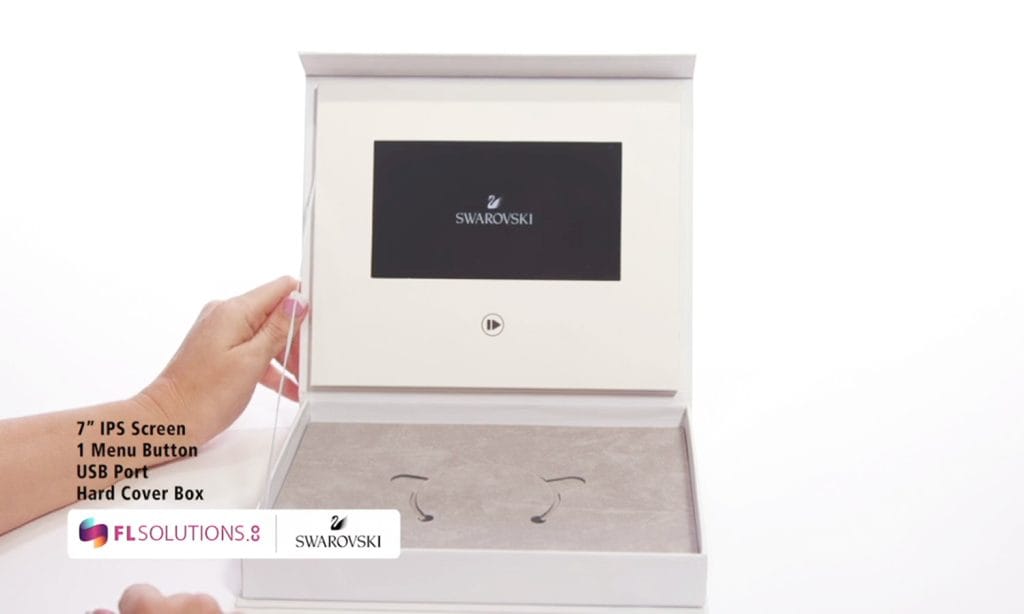
When you order a custom video box, screen technology is one of the few decisions that genuinely changes how the video looks in the recipient’s hands. Both LCD and IPS are flat-panel display types, and both work well for embedded video. The difference shows up in two places: color accuracy and viewing angle.
This guide explains the practical difference between LCD and IPS panels for video boxes, when each one is the right choice, and how the cost difference plays out in real campaigns.
For the broader topical guide, see the complete guide to video boxes. To order, head to the product page or call (727) 365-2937.
The Short Answer
LCD is the standard, lower-cost option. The video plays in good resolution at a 16:9 aspect ratio, and it looks great when the recipient watches the box head-on. The trade-off is a narrower viewing angle and slightly less color accuracy.
IPS is an upgraded panel type with wider 180-degree viewing angles and better color accuracy. The video reads correctly even when the box is held at an angle or shown to someone next to the recipient. The trade-off is a modest unit-cost premium.
For most B2B campaigns, LCD is fine. For luxury, fashion, food, healthcare, or any campaign where the unboxing will be filmed and posted to social, IPS is generally worth the upgrade.
Side-by-Side Comparison
| Feature | LCD | IPS |
|---|---|---|
| Color accuracy | Good | Excellent |
| Viewing angle | Narrow (best straight on) | Wide (180 degrees) |
| Resolution at 5″ | N/A — IPS only at 5″ | 800 x 480 |
| Resolution at 7″ | 800 x 480 | 800 x 272 |
| Resolution at 10″ | 1024 x 600 | 1024 x 600 |
| Aspect ratio | 16:9 | 16:9 |
| Battery life | 2-3 hours playback / 3-4 months standby | 2-3 hours playback / 3-4 months standby |
| Unit cost | Standard | Modest premium over LCD at same screen size |
| Best for | Most B2B outreach, donor cultivation, holiday gifting | Luxury, fashion, food, healthcare, filmed unboxings, executive ABM |
Color Accuracy: Why It Matters
LCD panels handle a strong color reproduction range that looks correct for most brand video. The difference between LCD and IPS in color shows up in two specific contexts.
Brand-color-critical industries. If your brand identity depends on the recipient seeing a precise color (the exact red of a Coca-Cola can, the exact gold of a luxury watch, the exact tone of skin in a beauty product shot), IPS reads truer. LCD can shift slightly warmer or cooler depending on the panel’s calibration and the angle of viewing. For most B2B outreach this doesn’t matter; for fashion, beauty, food and beverage, or healthcare campaigns it can.
Premium-feel campaigns. The visual difference between LCD and IPS is subtle but perceptible to a sophisticated audience. For executive outreach to enterprise accounts, donor cultivation at the major-gift level, or signature gifting at industry events, the IPS upgrade signals premium production values without anyone needing to be told.
Viewing Angle: 180 Degrees vs Head-On
This is the bigger practical difference between the two panel types.
LCD panels look their best when viewed straight on. As the viewing angle moves away from perpendicular, the image fades and colors shift. For a recipient watching alone at their desk with the box held directly in front of them, this is fine.
IPS panels maintain consistent brightness and color across a 180-degree viewing angle. The image reads correctly when the box is held at an angle, shown to a colleague sitting next to the recipient, or filmed by an influencer turning the box toward the camera.
The viewing-angle difference is the single biggest reason to choose IPS for any campaign where the unboxing will be filmed and posted to social, or where the recipient is likely to show the box to colleagues during a meeting.
When LCD Is the Right Call
LCD is the right pick for the majority of B2B campaigns. Specifically:
- Cost-sensitive runs. When the campaign needs to ship at scale and per-unit cost is a constraint, LCD keeps the budget reasonable.
- Voice-driven messages. If the video is primarily a person speaking to camera (founder welcome, sales rep introduction, donor thank-you message), color accuracy matters less than the audio and the personal connection.
- Internal gifting. Employee recognition, partner appreciation, team-wide holiday gifts. The recipient is already aligned with the brand; the visual signal is less important than the gesture.
- Direct mail at volume. When the recipient list is broad and the goal is response rate from a wide audience, LCD at lower unit cost lets the campaign reach more people for the same budget.
When IPS Is Worth the Upgrade
IPS is the right pick when any of the following apply:
- Color reproduction matters to the brand. Luxury, fashion, food and beverage, beauty, and healthcare campaigns generally benefit from IPS.
- The unboxing will be filmed. Influencer drops, PR mailers to creators, content-marketing campaigns where the box itself becomes social media content. IPS reads correctly on camera at any angle.
- Premium-tier outreach. Executive ABM campaigns to enterprise accounts, signature gifting at major industry events, VIP donor cultivation. The IPS upgrade reinforces the premium positioning.
- The box will be shown to multiple people. Meetings where the recipient passes the box around a table, or showrooms where the box is displayed for walk-ups. IPS keeps the image consistent for everyone.
What the Upgrade Costs
The IPS upgrade adds a modest per-unit cost over LCD at the same screen size. The exact difference varies with quantity and box dimensions, but as a rough guide (current as of 2026-05):
- 5″ IPS: adds about $5-$10 per unit over a 4.3″ LCD at the same quantity
- 7″ IPS: typically $5 or less premium over 7″ LCD
- 10.1″ IPS: this is the premium tier; LCD at 10.1″ is not offered as a standard option
For a 25-unit campaign, the IPS upgrade typically adds $125 to $250 in total cost. For the impact it produces on a brand-critical campaign, the math usually works.
For the current published rates, see the FL Solutions pricing sheet. Pricing updates annually.
Quick Decision Guide
If you can answer yes to any of these, lean toward IPS:
- Is your brand identity tied to a specific color (luxury, fashion, food, healthcare, beauty)?
- Will the unboxing be filmed or photographed for social content?
- Is this an executive ABM or named-account campaign?
- Will the box be shown to multiple people at once (meetings, showrooms)?
If the answers are all no, LCD is the right call and saves the budget for more units or larger screens.
For the screen-size decision, see the dedicated screen sizes guide. For the broader topical guide, see the complete guide to video boxes.
Frequently Asked Questions
What is the difference between LCD and IPS video box screens?
LCD and IPS are both flat-panel display technologies that work well for embedded video. IPS panels offer better color accuracy and wider viewing angles (180 degrees), which means the video looks correct even when the recipient holds the box at an off-axis angle or shows it to someone next to them. LCD is the lower-cost standard and is fine for most B2B campaigns. IPS is generally worth the upgrade for luxury, fashion, food, healthcare, or any campaign where the unboxing will be filmed.
Which is better for video boxes, LCD or IPS?
Neither is universally better. LCD is the right call for cost-sensitive B2B outreach and internal gifting. IPS is the right call for brand-color-critical campaigns, filmed unboxings, and executive ABM. The right choice depends on the campaign goals, not the technology itself.
How much more does an IPS video box cost?
The IPS upgrade adds a modest premium over LCD at the same screen size. A 5 inch IPS typically adds $5 to $10 per unit over a 4.3 inch LCD at the same quantity. A 7 inch IPS is typically $5 or less above a 7 inch LCD. For a 25-unit campaign, the total IPS upgrade cost is usually $125 to $250.
Why do IPS screens have wider viewing angles?
IPS panels use a different liquid-crystal alignment technology that keeps brightness and color consistent across a wider viewing range. LCD panels are optimized for head-on viewing and shift in brightness and color when viewed from an angle. The practical result: an IPS video box can be held at an angle, passed around a meeting table, or filmed from any direction and still look correct.
Is IPS better for filmed unboxings?
Yes. When an influencer or content creator films an unboxing, they often turn the box toward the camera at angles that an LCD panel would not handle well. IPS keeps the video on the screen looking correct in the recorded footage. For any campaign where the box itself becomes social media content, IPS is the right choice.
Are both LCD and IPS available in all screen sizes?
No. LCD is available at 2.4 inch, 3 inch, 4.3 inch, 7 inch, and 10 inch. IPS is available at 5 inch, 7 inch, and 10.1 inch. The 5 inch and 10.1 inch sizes are IPS-only options in the FL Solutions lineup.
Does IPS use more battery than LCD?
No. Battery life is consistent across both panel types: two to three hours of continuous playback per charge, with three to four months of standby life. The battery is rechargeable via the USB cable that ships with every unit.
Can I order a sample to compare LCD and IPS in person?
Yes. Order sample video boxes through the FL Solutions shop. Samples ship in either 4.3 inch LCD or 7 inch (LCD or IPS); specify your preference in the order notes. The sample cost is refunded when the order converts to a full production run.
Ready to Choose Your Screen Tech?
If you know whether LCD or IPS fits your campaign, head to the estimate form and submit your specs. The FL Solutions team responds with a quote that accounts for your screen choice. For questions or to talk through the right screen tech for your brand, call (727) 365-2937.
For broader context on what video boxes are and how they work, see what is a video box. For the screen-size decision, see the screen sizes guide. For the full topical guide, see the complete guide to video boxes.
Watch FL Solutions on YouTube for video walkthroughs on screen sizes, LCD vs IPS, real client campaigns, and more.